Review · Women's Health
FemiCore review: the probiotic capsule built around your bladder's own bacteria
Can FemiCore's probiotics really rebalance your bladder and stop leaks?
A sneeze, a laugh or a sudden urge: FemiCore is one daily capsule sold for those everyday leaks, and the research points to the sudden-urge kind. It combines five Lactobacillus strains, including L. crispatus, which a 2014 study found more often in women without urgency leaks, with cranberry, bearberry, mimosa pudica and berberine. It costs $49 to $79 a bottle, one-time purchase, with a 60-day refund even on empty bottles; FemiCore itself hasn't been tested on its own yet.
- 1 capsule every morning, 30 capsules a bottle
- A 350 mg herbal blend plus a 50 mg blend of five probiotic strains
- Sold to rebalance the urinary microbiome
- One-time purchase, 60-day money-back guarantee
This review is based on FemiCore's sales page, label, FAQ and order page (prices checked on Oct 13 and again on Nov 17, 2026) and the research linked in the sources. We have not tested FemiCore. It is not medical advice. How we review
Why do bladder leaks start, and why are they so hard to talk about?
A sneeze in the supermarket. A laugh at dinner that you have to cut short. The quiet math before every trip: where's the nearest restroom, is this the day for the dark pants. Most women with leaks never say a word about it, not even to their doctor.
You're far from alone. The National Institute of Diabetes and Digestive and Kidney Diseases (NIDDK) estimates that about half of all women experience urinary incontinence at some point, and the risk rises with pregnancy, childbirth and menopause [1]. These are the types most women have:
- Stress incontinence: a cough, sneeze, laugh or workout presses on the bladder and some urine escapes.
- Urgency incontinence: a sudden, strong need to go, and the leak comes before you reach a toilet. It's often called overactive bladder.
- Mixed: both, which is common.
If yours come mostly with a sneeze or a laugh, our guide Why do I leak when I sneeze? explains what weakens the pelvic floor. Pads and Kegels are what most women try first. FemiCore promises something different: a capsule that works on the bacteria inside the bladder.
What is FemiCore, and how is the urinary microbiome idea supposed to work?
FemiCore is a dietary supplement for women: one capsule each morning with a big glass of water, 30 capsules a bottle. Its sales page tells a three-step story:
- The cause: your bladder has its own community of bacteria, the urinary microbiome, and the FAQ says "toxic dioxins" can "throw your urinary microbiome out of balance, leading to uncontrollable pee leaks".
- The fix: the five Lactobacillus strains are meant to be "repopulating your urinary microbiome with good bacteria", while cranberry, bearberry, mimosa pudica and berberine support the urinary tract.
- The result: fewer sudden urges and leaks, according to the brand.
The first step has some science behind it. A study in mBio in 2014 compared 60 women with urgency incontinence and 58 without, and found different bacteria in their urine. Lactobacillus crispatus, one of FemiCore's strains, showed up more often in the women without leaks [2]. The study was small and didn't test a capsule, and the dioxin part of the story comes from the sales page rather than from research, but the core idea, supporting the good bacteria in the bladder, is exactly what FemiCore is built on.

What is in FemiCore, and what do the studies say about each ingredient?
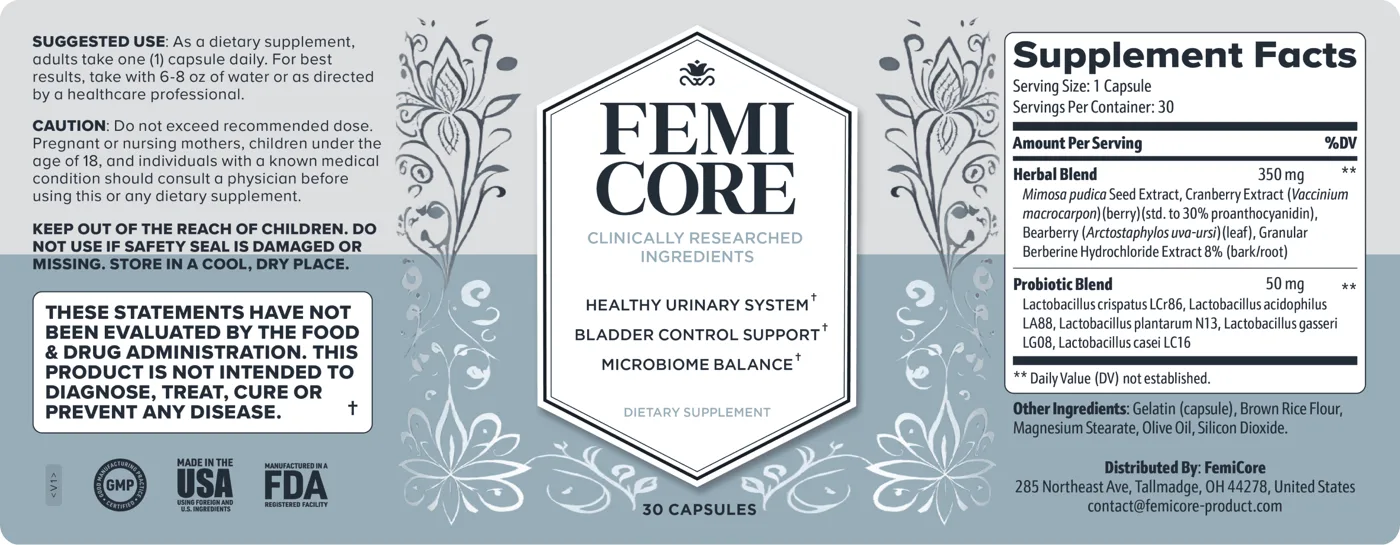
Nine ingredients in two blends, with no amount for each one. The label lists a 350 mg herbal blend and a 50 mg probiotic blend per capsule [10], so nobody can compare each dose with the studies. The capsule is gelatin, so FemiCore isn't vegetarian. Here is what the research says, starting with the ingredients closest to the microbiome idea.
A related note on L. crispatus: a small 2011 trial used a different strain as a vaginal suppository, not a capsule, against repeat urinary infections [7].





Is FemiCore better for stress leaks or for urgency leaks?
Where FemiCore fits best: urgency leaks, the sudden "I have to go now" kind. That's where the research behind it points, so it's worth knowing which kind of leaks you have.
Urgency leaks are the sudden "I have to go now" moments, the key in the door and the dash to the bathroom. The 2014 mBio study that FemiCore's idea rests on looked at exactly this group: women with urgency incontinence had different bladder bacteria from women without it [2]. So if you mostly leak with a sudden urge, the microbiome idea at least aims at your kind of problem, even if no one has shown that a capsule changes it.
Stress leaks are the sneeze, the cough, the jump on the trampoline with the kids. They come from pressure on the bladder and a pelvic floor that doesn't hold, often after childbirth or with menopause, as the NIDDK explains [1]. No study links them to bladder bacteria, and a probiotic can't strengthen a muscle. If this is you, pelvic floor exercises are the main tool, and FemiCore would be a small add-on.
Mixed leaks, both kinds together, are common. If that's you, a sensible split is FemiCore for the urges and pelvic floor work for the sneezes, as long as you track both kinds separately in your diary, so you can see which one, if any, changes.
Check the three FemiCore packs on the official site.
FemiCore, Kegel exercises or bladder medicine: which fits your leaks?
Most women reading this have already tried pads, and many have tried Kegels. The NIDDK lists the first steps for bladder control: pelvic floor exercises, bladder training, a bladder diary, less caffeine and alcohol, a healthy weight and avoiding constipation, with medicines and procedures if those aren't enough [9]. FemiCore doesn't replace any of that; it's an add-on to those steps. Our FemiCore vs Kegel exercises guide goes deeper.
| Option | What we know | Worth testing for |
|---|---|---|
| FemiCore | Probiotics and urinary herbs in one daily capsule; one-time purchase; 60-day refund; $49 to $79 a bottle. | Women with mild leaks who want to add a supplement and test it. |
| Pelvic floor (Kegel) exercises | First-line advice from the NIDDK; best done with a provider who checks you squeeze the right muscles. | Stress leaks from a sneeze, cough or laugh; free. |
| Bladder training and a bladder diary | Recommended by the NIDDK, especially for urgency. | Sudden urges and frequent trips. |
| Prescription medicine or a procedure | Options a doctor can offer when the basics aren't enough, per the NIDDK. | Leaks that keep changing your life. |
What are the pros and cons of FemiCore?
The pros cover what most women want: one capsule, a real idea behind it and a generous refund. Each con comes with a simple fix below.
Pros
- One capsule a day, an easy routine to keep
- Built on a real, if early, idea: different bladder bacteria in women with urgency leaks
- Cranberry standardized to 30% proanthocyanidins, the most studied cranberry compounds
- One-time purchase with no autoship
- 60-day money-back guarantee, even on empty bottles
Cons
- No study of FemiCore itself yet, and the label lists two blends without each amount. A short bladder diary over 60 days tells you how it works for you, and the refund covers the test.
- Bearberry is traditionally used for short periods. Because this test already runs for weeks, show the label to your doctor before you start.
The 60-day refund lets you weigh these against your own diary.
Is FemiCore safe? Side effects and when to ask a doctor first
For most adult women, stomach upset is the likely side effect, but four situations need a doctor first. No side effects are listed on the sales page; the label asks pregnant or nursing women, anyone under 18 and anyone with a medical condition to check with a doctor. The National Center for Complementary and Integrative Health (NCCIH) covers cranberry [4] and berberine, in its NIH news page on the supplement [6], and the European Medicines Agency covers bearberry [5].
| If you… | Why it matters | What to do |
|---|---|---|
| Get an upset stomach, nausea, diarrhea or constipation | These are berberine's most common side effects; lots of cranberry can also upset the stomach. | Take it with breakfast. If it doesn't settle, stop and ask your doctor. |
| Are pregnant or breastfeeding | The NIH says berberine should not be used during pregnancy or breastfeeding. | Don't take it unless your doctor says it's fine. |
| Take prescription medicines | Berberine may interact with medicines, and the NCCIH notes conflicting evidence on cranberry and the blood thinner warfarin. | Show the label to your doctor or pharmacist, especially for blood thinners or diabetes medicine. |
| Have kidney problems | The European Medicines Agency says bearberry leaf medicines are not for people with kidney disorders. | Ask your doctor before using it. |
| Leak with pain, burning, blood or fever, or leaks start suddenly | These can be signs of an infection or another problem; cranberry doesn't treat an existing infection. | See a doctor first. A supplement isn't the answer here. |
Who is FemiCore for?
Try FemiCore if:
- Your leaks are mild and come mostly with sudden urges, or are mixed, and a doctor has ruled out an infection.
- You're already doing, or willing to do, pelvic floor exercises and want to add something simple.
- You like the microbiome idea and will keep a short bladder diary for 60 days.
Better to wait, or talk to your doctor first, if your leaks come only with a sneeze or a laugh (pelvic floor exercises are the main tool there), if you're pregnant, breastfeeding or have kidney problems, or if leaks come with pain, blood or fever; those call for your doctor first.
If you're in the first list, the 3-bottle pack is the fairest test.
What habits help bladder control, with or without FemiCore?
The steps that help most cost nothing, and they also make a FemiCore test fairer, because you'll know what's really changing. These are the self-care steps the NIDDK lists for bladder control problems [9]; a doctor or pelvic floor therapist can help you do them right.
- Pelvic floor (Kegel) exercises. Stronger pelvic floor muscles hold urine better. A provider can check that you're squeezing the right muscles. Don't practice them while urinating.
- Bladder training. Go on a schedule and slowly stretch the time between trips, so the bladder learns to hold more.
- A bladder diary. Write down what you drink, when you go and when you leak. It's the same diary that tells you whether FemiCore is doing anything, and it helps your doctor too.
- Less caffeine and alcohol. Caffeine can trigger leaks, and alcohol makes the body produce more urine.
- Smart fluids. Ask your provider whether to drink less at certain times, without getting dehydrated.
- A healthy weight and no constipation. The NIDDK says losing weight can mean fewer leaks, and constipation can make bladder problems worse.
- Calm the urge. When a sudden urge hits, hold still, take a few slow breaths or do quick, strong pelvic floor squeezes before walking to the bathroom.
Starting these at the same time as FemiCore makes it harder to tell which one helped. If you can, begin the habits two weeks earlier, then add the capsule.
How much does FemiCore cost, and which pack makes sense?
FemiCore costs $49 to $79 a bottle, and one bottle lasts 30 days: about $2.63 a day with 2 bottles, $2.30 with 3 and $1.63 with 6.
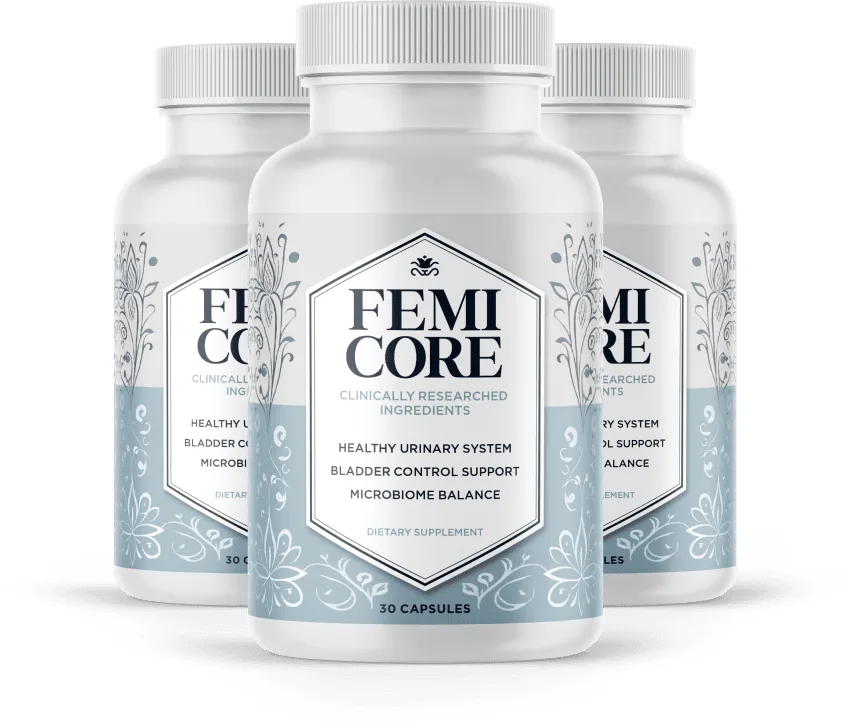
Which one to pick: 3 bottles. 2 bottles cost $167.99 with shipping; 3 bottles cost $207, with free or $15.95 shipping by address, so the third bottle can cost as little as $39 more. You don't have to wait until day 90 to decide: on day 50 you check your diary; if nothing changed, you ask for the refund, which covers every bottle, opened or not, and if it's working, the third bottle takes you to day 90 without reordering. Probiotic and cranberry studies run for weeks to months, so the extra month helps. Bearberry is traditionally a short-term herb, so check with your doctor before you plan on 90 days. Six bottles are the cheapest per bottle, but $294 is a lot to pay before you know.
The 6-bottle pack adds three e-books (on marriage, digestion and hip mobility). They're extras, not a reason to buy more. Prices checked on Nov 17, 2026.

3 bottles (2 + 1)
$207 ($69 a bottle)
90-day supply; shipping is free or $15.95 by address.

6 bottles (3 + 3)
$294 ($49 a bottle)
180-day supply and 3 e-book bonuses; shipping is free or $15.95 by address.
Can you get your money back if FemiCore doesn't help?
Yes. Every order has a 60-day money-back guarantee, counted from delivery: write to support, send back all the bottles, empty or not, with the packing slip, and you get a full refund. You pay the return postage. It's a one-time purchase, with no autoship or hidden charges, according to the order page.
Make the test count:
- For three days before the first capsule, write down your leaks, urgent trips and night trips. That's your starting point.
- Repeat the diary for a few days at week 4 and week 7.
- No change by day 50 after delivery? Ask for the refund then, so you're well inside the 60 days. Keep the packing slip.
Shipping is $9.99 on 2 bottles; on 3 and 6 it's free or $15.95, depending on your address.
Order through the official site and keep the packing slip for the refund.
Is FemiCore legit or a scam?
It's legitimate. FemiCore is a real product whose label shows all nine ingredients, with a distributor, the maker's contact email and a written refund policy. Here's what we looked at:
- The idea. Built on real research: women with urgency leaks had different bladder bacteria in a 2014 study, and L. crispatus, one of FemiCore's strains, was more common in women without leaks.
- The label. All nine ingredients are shown, in two blends, without each amount. The label says it's made in an FDA-registered facility; as with any supplement, what it promises hasn't been reviewed by the Food and Drug Administration (FDA).
- Complaints. In October 2026 we found no Better Business Bureau (BBB) profile and no complaints, and only Trustpilot profiles for other websites with 0 to 2 reviews.
- Where to buy. Several sites use similar names; the official site is the one with the refund.
Our verdict: a sensible daily capsule for mild urgency leaks, with all nine ingredients on the label. Order 3 bottles from the official site and let your bladder diary tell you how it's going.
Lookalike sites don't carry the refund; the official site does.
FemiCore FAQ
Does FemiCore work for bladder leaks?
It's built on a promising idea: women with urgency leaks had different bladder bacteria in a 2014 study. No study of FemiCore itself has been published yet, so judge it over 60 days with the refund as your safety net.
How does FemiCore work, according to the brand?
Its five Lactobacillus strains are meant to repopulate the urinary microbiome with good bacteria, while cranberry, bearberry, mimosa pudica and berberine support the urinary tract.
What are the FemiCore ingredients?
Mimosa pudica seed, cranberry extract (30% proanthocyanidins), bearberry leaf and berberine in a 350 mg herbal blend, plus L. crispatus, L. acidophilus, L. plantarum, L. gasseri and L. casei in a 50 mg probiotic blend.
How long does FemiCore take to work?
No timeline is published. Probiotic and cranberry studies run for weeks to months, so judge it with a bladder diary over 60 days or more.
Can FemiCore replace Kegel exercises?
No. Pelvic floor exercises are first-line advice from the NIDDK; FemiCore can only complement them.
Is FemiCore safe?
Stomach upset is the most likely side effect. Berberine is not for pregnancy or breastfeeding and may interact with medicines, and bearberry is not for kidney problems.
Can I take FemiCore with my medications?
Show the label to your doctor or pharmacist first, especially if you take blood thinners or diabetes medicine.
How do I take FemiCore?
One capsule a day; the label says with 6 to 8 oz of water, and the sales page suggests taking it in the morning.
How much does FemiCore cost?
$158 for 2 bottles plus $9.99 shipping, $207 for 3 and $294 for 6, with free or $15.95 shipping by address, checked on Nov 17, 2026.
Is FemiCore a subscription?
No. The order page says it's a one-time purchase with no autoship or hidden charges.
Is FemiCore vegetarian?
No, the capsule is made of gelatin.
Is FemiCore on Amazon?
It's sold through its official site; the 60-day refund and pack prices only apply there.
Is FemiCore a scam?
FemiCore isn't a scam: its label shows all nine ingredients, in two blends without each amount, the price is one-time and you get a 60-day refund.
Sources
Research links checked in October 2026; prices and terms checked again on Nov 17, 2026.
- NIDDK (US National Institutes of Health). Definition & facts for bladder control problems (urinary incontinence). Link
- Pearce MM et al. The female urinary microbiome: a comparison of women with and without urgency urinary incontinence. mBio, 2014. Link
- Williams G et al. Cranberries for preventing urinary tract infections. Cochrane Database of Systematic Reviews, 2023. Link
- NCCIH (US National Institutes of Health). Cranberry. Link
- European Medicines Agency. Uvae ursi folium (bearberry leaf), herbal medicinal product. Link
- NCCIH (US National Institutes of Health). In the News: Berberine. Link
- Stapleton AE et al. Randomized, placebo-controlled phase 2 trial of a Lactobacillus crispatus probiotic given intravaginally for prevention of recurrent urinary tract infection. Clinical Infectious Diseases, 2011. Link
- Schwenger EM et al. Probiotics for preventing urinary tract infections in adults and children. Cochrane Database of Systematic Reviews, 2015. Link
- NIDDK (US National Institutes of Health). Treatments for bladder control problems (urinary incontinence). Link
- FemiCore. Supplement Facts label, sales page, FAQ and order page (official site), checked on Oct 13 and Nov 17, 2026.
So, is FemiCore worth trying for bladder leaks?
For mild urgency or mixed leaks, yes: a simple daily capsule built on a promising idea, next to pelvic floor exercises. Buy 3 bottles, start on a Monday, keep a short bladder diary, and the 60-day refund covers you if it isn't for you. If you're pregnant or have kidney problems, ask your doctor first.