Review · Gadgets
BlueLume Glasses review: can one self-adjusting pair really focus near and far?
Do BlueLume Glasses really focus near and far with one pair?
According to the maker, the Auto-Adjust Lens System gives near, intermediate and distance focus in one pair, but it does not say how the lens does it or what power it has. The self-focusing glasses in the published research we found (Stanford, 2019) were battery-powered prototypes with eye tracking, and the maker mentions no battery. BlueLume Glasses were listed at $88.86, or $44.43 on promotion, with no published guarantee.
- One pair for near, middle and far, according to the maker
- Photochromic lenses: dark outside, clear inside, per the maker
- Blue light filter and a frame under 1 ounce, per the maker
- One pair, one price: no packs, no bonuses
This review is based on the maker's sales page (prices as listed on Oct 29, 2026, page checked on Oct 30, 2026) and the eye health sources linked below, checked on Nov 4, 2026. Claims about the lens are as described by the maker. We have not tested the glasses. It is not medical advice. How we review
Why do people in their mid-40s and older end up juggling two or three pairs of glasses?
Because the eye's own focusing system stiffens with age, and it happens to everyone. The National Eye Institute (NEI), part of the National Institutes of Health (NIH), puts it plainly: "Everyone gets presbyopia as they get older." It usually starts after age 45. The signs it lists are familiar: trouble seeing things up close, holding reading material farther away, tired eyes and headaches.
MedlinePlus explains the cause: the lens inside the eye has to change shape to focus close up, and "this elasticity decreases slowly as people age." It also notes that reading prescriptions keep changing for years, and that by about 65 most of that elasticity is gone.
That is where the pile of glasses comes from: one pair for close work, maybe one for distance, sunglasses for the drive, and a new purchase each time the prescription changes.
BlueLume Glasses are aimed at exactly that frustration. The question for this review is not whether the problem is real (it is), but whether one self-adjusting pair is a believable answer to it.
What is the BlueLume Auto-Adjust Lens System, and how does the maker say it works?
The Auto-Adjust Lens System is the maker's name for the lens that, it says, covers near, intermediate and distance viewing in one pair of BlueLume Glasses. According to the maker, you put the glasses on, look through them as usual, and as your eyes move from a book or a phone to a television or a road sign, "the lens system helps provide the focus needed for that distance." The maker describes BlueLume Glasses as "self-adjusting" and says optical engineers with medical and aerospace backgrounds designed them.
The maker adds four extras on top of the main promise: photochromic lenses that darken in sunlight and clear indoors, a filter for blue light from screens, a frame under one ounce, and a build meant to handle everyday bumps and drops.
What the maker does not say is just as important for a buyer. The sales page gives no lens material, no lens power (the plus or minus number on any prescription), no prescription option, no explanation of the "auto-adjust" part, and no mention of a battery, a charger, a button or a dial. Those missing details matter, because the way a lens reaches near and far changes who it can help.
One detail: on the product photo, the temple lettering appears to read "Blue View". Compare it with the pair that arrives.
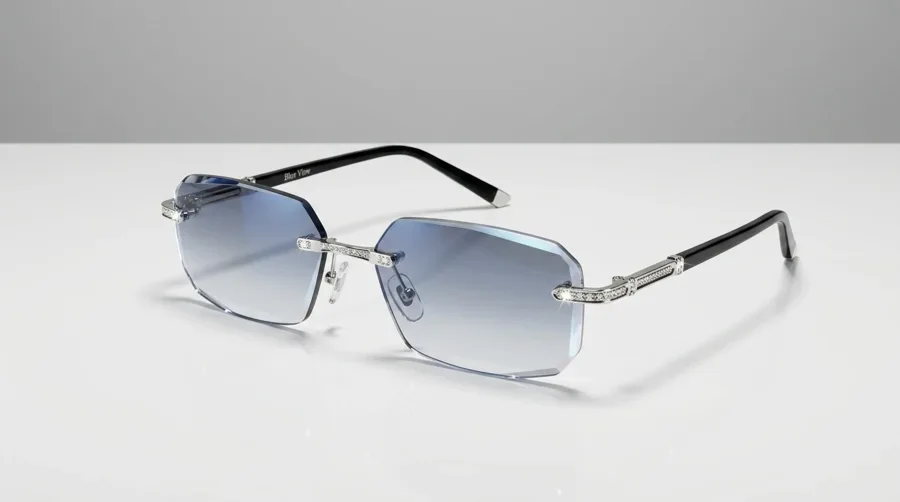
See how the maker presents the lens before deciding.
Can a single lens give near and far focus? What the research says
Yes. These are the main ways it is done, and each comes with trade-offs. Since the maker does not say which one BlueLume Glasses use, here is what each would mean, with the evidence behind it.
Lenses that truly refocus by themselves. This is what "auto-adjust" suggests. The best-known research is a 2019 study at Stanford published in Science Advances and archived in PubMed Central. The team built "autofocals": glasses with electronically controlled liquid lenses, eye trackers and a depth camera. In 19 users, the prototype was comparable to progressive lenses overall and better at close distance, and in a second group "23 of 37 users ranked autofocals as the best correction in terms of ease of refocusing." The same paper points out that "both focus-tunable lenses and eye trackers require batteries," and its device was "a tethered system". The American Academy of Ophthalmology (AAO) EyeNet Magazine reported it as a prototype and said comfort and ease of use "warrant further exploration." In short: self-focusing glasses are possible, but the version tested in that study was powered and wired. BlueLume's page mentions no power source.
Lenses with zones. Bifocal and progressive lenses do not change at all; they have different strengths in different parts of the lens, and you choose the distance by where you look through it. MedlinePlus says that "in some cases, adding bifocals to an existing lens prescription is the best solution." A zoned lens could fit the maker's description of near, intermediate and far, but it would need to match your eyes to work well, and the maker offers no prescription.
Ready-made strength. Over-the-counter readers use one fixed strength. The NEI notes that "some people use over-the-counter reading glasses" for presbyopia. If BlueLume Glasses use a fixed or ready-made design, the result will depend on how close your eyes are to that design.
The extras. On the blue light filter, the evidence points the other way: the AAO does not recommend blue-light-blocking glasses for eye strain, and a Cochrane review found such lenses "may not attenuate symptoms of eye strain with computer use" in the short term. On the darkening lenses, the U.S. Food and Drug Administration (FDA) warns that a dark lens is not proof of UV protection. The four features of BlueLume Glasses, one by one:
What to expect from BlueLume Glasses in the first weeks
The maker publishes no timeline, and no one can promise how a lens will work for your eyes. This plan helps you find out quickly, while a return is still realistic.
| When | What to do | Why |
|---|---|---|
| Before ordering | Write down the strength of the readers you use now (for example +1.50) and when you last had an eye exam. | It gives you something to compare with, since BlueLume Glasses list no lens power. |
| Day 1 | Test three distances in good light: a phone at reading distance, a computer screen at arm's length, a sign or TV across the room. | Those are the near, intermediate and far distances the maker names. |
| Days 2 to 7 | Wear them for normal tasks, but not for driving until you are sure distance vision is sharp and steady. | New lenses can feel strange at first; the road is not the place to find out. |
| Week 2 | Step outside and back inside, and check how fast the lenses darken and clear. Look at the lens or case for a UV400 label. | The FDA says lens color does not show UV protection. |
| Weeks 2 to 4 | Decide. If you still reach for your old readers, or get headaches, stop and use the return terms. | A pair that does not suit your eyes will not improve with time. |
Plan your test before the order arrives.
BlueLume Glasses pros and cons
Our own reading of the offer, the maker's claims and the NEI, AAO, Cochrane and FDA sources.
Pros
- One pair that aims to replace readers, distance glasses and sunglasses
- Low promo price ($44.43) compared with a prescription pair
- Photochromic tint saves carrying separate sunglasses, if the UV protection is confirmed
- Very light frame, under 1 ounce according to the maker
- Single purchase with one price: no packs to compare and no bonuses to sort out
Cons
- The Auto-Adjust Lens System is not explained: no lens type, no lens power, no prescription option
- Research on self-focusing glasses uses powered prototypes; the maker mentions no power source
- No guarantee, return window or shipping terms published
- Blue light filter: eye doctors say it does not ease eye strain
- No UV rating shown for the darkening lenses
- Sales page written like a news story; its own footer says it is an advertisement
If the pros matter more to you, check today's price.
What do the testimonials on the maker's page say?
The maker's page shows six short testimonials, signed with a first name, an initial and an age between 37 and 58. We have not verified them. Read together, they say three things: the writers no longer carry two pairs, they like the light frame, and they like that the lenses darken outdoors. One mentions the blue light filter for long screen sessions.
What none of them gives is just as telling: no prescription, no reading strength used before, no eye exam and no description of how sharp distance vision is. They describe convenience, which is the maker's pitch, not proof that the Auto-Adjust Lens System focuses well for a given pair of eyes.
Are BlueLume Glasses safe? Possible problems and when to see an eye doctor
Glasses are low risk, but a lens that does not match your eyes can cause discomfort, and new vision symptoms should never be blamed on presbyopia without a check. MedlinePlus advises contacting a provider "if you have eye strain or have trouble focusing on close objects." Its page on retinal detachment says a retinal detachment, which can start with new flashes of light and floaters, is an "urgent problem that requires medical attention within 24 hours."
| Situation | Why it matters | What to do |
|---|---|---|
| Headache, eye strain or dizziness while wearing them | A lens power that does not suit your eyes can cause this. | Stop wearing them and compare with your usual glasses. If it continues without them, see an eye doctor. |
| Blurry distance vision | The maker gives no distance power, so it may not match your needs. | Do not drive in them until distance is clearly sharp. |
| New flashes of light, sudden floaters or a curtain over your sight | MedlinePlus lists these as signs of retinal detachment, an urgent problem. | Get care within 24 hours; new glasses will not help. |
| Diabetes, glaucoma or a known eye disease | Your eye doctor follows your eyes and knows your prescription. | Ask your eye doctor before replacing prescribed glasses. |
| Astigmatism or very different eyes | The maker lists no option for a different strength in each eye. | Ask an eye doctor whether a non-prescription pair can work for you. |
| Bright sun, snow or water | No UV rating is published for the darkening lenses. | Use sunglasses labeled UV400 until the maker confirms the rating. |
Who are BlueLume Glasses for, and who should skip them?
BlueLume Glasses can make sense for:
- Adults with early presbyopia who now use drugstore readers and are tired of losing them.
- People who want a light spare pair for the house, the desk or travel and are willing to test it.
- Buyers who see $44.43 as a small experiment and can live with the risk if the return terms are weak.
They are probably not for:
- Anyone with a strong distance prescription, astigmatism or very different eyes: the maker offers no prescription.
- People who already wear progressives that work for them; there is no published reason to think BlueLume Glasses do better.
- Drivers who need guaranteed sharp distance vision, until they have tested the pair safely.
- Anyone buying only for the blue light filter, which eye doctors do not recommend for eye strain.
- Anyone who has not had an eye exam in years: an exam can find problems no glasses fix.
Sounds like you? See the offer on the maker's page.
What habits help tired eyes, with or without BlueLume Glasses?
Small habits often help more than any filter. The AAO page on computers, digital devices and eye strain explains that people normally blink about 15 times a minute but only "about 5 to 7 times in a minute while using computers," which dries the eyes. Its advice:
- Sit about 25 inches from the screen, roughly arm's length.
- Give your eyes regular breaks by looking away from the screen at something far.
- Reduce glare and match screen brightness to the room.
- Use artificial tears if your eyes feel dry.
The same page adds that "computer glasses for reducing eye strain are not the same as 'blue light blocking' glasses." In other words, if screens are your main problem, a lens set for screen distance matters more than a blue tint.
For close work in early presbyopia, the NEI suggests brighter reading lights, bigger print and a larger computer font. Those habits cost nothing and work whatever glasses you choose.
How much do BlueLume Glasses cost, and is the promo worth it?
BlueLume Glasses come as a single pair. The maker's page listed a regular price of $88.86 and a 50% promotion at $44.43, marked "today only" and ending Oct 29, 2026. There are no multi-packs and no bonuses.
A few numbers to put that in context. Worn every day for a year, the promo pair works out to about 12 cents a day, and the regular price to about 24 cents. The value is real only if one pair truly replaces two or three for your eyes. The maker compares itself with prescription glasses at $200 to $400; that comparison is the maker's, and a prescription pair is made for your eyes, which BlueLume Glasses are not.
Because the promotion was labeled as ending on a date that has passed, the checkout is the only place that shows today's price and any shipping charge.
1 pair of BlueLume Glasses
$44.43 promo (regular $88.86)
Prices as listed on the maker's page on Oct 29, 2026. Shipping cost not published: the checkout shows it for your address.
Do BlueLume Glasses have a money-back guarantee?
Not one that we could find. The sales page publishes no money-back guarantee, no return window, no warranty and no shipping time or cost; it only says that "express shipping" is available.
For a product whose whole promise depends on how it works with your eyes, that matters. Before paying, save a screenshot of the return rules on the order page: how long you have, the cost of sending the pair back, how much of the price comes back to you, and how to contact the seller.
If the order page gives at least 30 days, there is time for a full test at home. If it shows no return terms, assume you are buying without them.
Find the return terms on the order page first.
Are BlueLume Glasses legit or a scam?
We found no proof that BlueLume Glasses are a scam, and no proof that the Auto-Adjust Lens System works as described. Both are worth keeping in mind.
Does the mechanism have support? The idea, yes: one-pair near-to-far glasses exist. This product, unproven: the maker names none of the parts the Stanford prototype needed.
How it is sold. The sales page looks like a news report about what doctors think, but names no doctor, and its own footer says the site "is an advertisement and not a news publication."
Complaints. We searched Trustpilot and the Better Business Bureau (BBB) for BlueLume Glasses and found no profile for this product. Results for companies with similar names are not about it, so we leave them out. No profile means there is nothing to report yet, not that buyers are happy.
The rating. The page shows "4.7 out of 5" from "27,392+ verified owners". We have no way to check that number.
Our view: treat BlueLume Glasses as an untested gadget at a modest price, not as a replacement for an eye exam or a prescription.
Judge the offer yourself on the maker's page.
Key terms explained
- Presbyopia
- The normal, age-related loss of close-up focus. It usually starts after 45 and affects everyone eventually.
- Auto-Adjust Lens System
- What BlueLume calls its lens for three distances (close, middle, far). How it adjusts is not disclosed.
- Autofocals
- Research glasses with liquid lenses that refocus automatically, guided by eye trackers. Tested as battery-powered prototypes.
- Progressive lens
- A lens with no visible lines whose strength changes gradually from distance at the top to reading at the bottom.
- Diopter
- The unit of lens power, shown as numbers like +1.50 on reading glasses.
- Photochromic lens
- A lens that darkens in sunlight and clears indoors.
- UV400
- A label meaning the lens blocks almost all UVA and UVB rays.
BlueLume Glasses FAQ
What are BlueLume Glasses?
A pair of lightweight glasses that, according to the maker, use an Auto-Adjust Lens System to focus at near, intermediate and far distances, with photochromic lenses and a blue light filter. They are sold online as a single pair.
How does the BlueLume Auto-Adjust Lens System work?
The maker says that as your eyes move from close objects to far ones, the lens system helps provide the focus needed for that distance. It does not explain the technology, the lens type or the lens power.
Do BlueLume Glasses need charging or batteries?
The maker's page mentions no battery, charger or switch. That matters, because the self-focusing glasses tested in research, such as the Stanford autofocal prototype, needed batteries for their liquid lenses and eye trackers.
Do BlueLume Glasses work for reading?
The maker says they help with near focus, for example a book, a menu or a phone. Without a published lens power, we cannot say how strong that help is. If you use readers now, compare both pairs at the same distance.
Can BlueLume Glasses replace my prescription glasses?
The maker offers no prescription option, so they are not made for your specific eyes. If you have a prescription, astigmatism or an eye condition, ask your eye doctor before replacing your glasses.
Can I drive with BlueLume Glasses?
Only once you have checked, away from the road, that distance vision is sharp and steady with them. The maker publishes no distance power, so do not assume they replace your driving glasses.
Does the BlueLume blue light filter help with eye strain?
Probably not much. Ophthalmologists at the AAO advise against buying blue light glasses for tired eyes, and the Cochrane authors saw no clear short-term gain. Blinking more, screen breaks and keeping the screen at arm's length help more.
Do BlueLume Glasses block UV?
The maker says the lenses darken in bright light but shows no UV rating. The FDA advises looking for a UV400 or "100% UV protection" label, so ask for it before relying on them as sunglasses.
How much do BlueLume Glasses cost?
One pair was $44.43 on promotion when we checked, half the $88.86 regular price. Worn daily for a year, that is about 12 cents a day on promo or 24 cents at full price. The order page has the current price.
Is there a BlueLume Glasses guarantee or refund?
We found no published guarantee or return window. Look for the return terms on the order page and save them before paying.
What strength are BlueLume Glasses?
The maker does not publish one. There is no plus number, as on drugstore readers, and no prescription range. If you know your reading strength, ask the seller which strength the lenses have before you order.
Can I wear BlueLume Glasses at the computer all day?
The maker says they cover intermediate distance, which includes a screen at arm's length, and that the frame weighs under one ounce. Whether the screen looks sharp depends on the lens power, which is not published. Test it on day one.
Are BlueLume Glasses a scam?
We found no complaints and no profile on Trustpilot or the BBB, and also no proof the lens works as described. The sales page is an advertisement written like news. Buy only if you can return them.
Sources
Official pages and research used for this review, checked on Nov 4, 2026.
- National Eye Institute (NEI, National Institutes of Health). Presbyopia. Link
- MedlinePlus Medical Encyclopedia (National Library of Medicine). Presbyopia. Link
- Padmanaban N, Konrad R, Wetzstein G. Autofocals: Evaluating gaze-contingent eyeglasses for presbyopes. Science Advances, 2019 (PubMed Central). Link
- American Academy of Ophthalmology, EyeNet. Autofocals: Gaze-Contingent Eyeglasses for Presbyopes, Sept 2019. Link
- American Academy of Ophthalmology. Computers, Digital Devices, and Eye Strain. Link
- American Academy of Ophthalmology. Are computer glasses worth it? Link
- Cochrane. Do blue-light filtering spectacles reduce eye strain or improve sleep quality? Link
- U.S. Food and Drug Administration (FDA). Tips to stay safe in the sun: from sunscreen to sunglasses. Link
Should you try BlueLume Glasses?
If you are tired of hunting for your readers and the near-to-far idea fits how you live, the promo price makes BlueLume Glasses a small test. Check today's price on the maker's page and keep the return terms before you pay.
Want to know where to buy the original BlueLume Glasses and today's price? See our page on the original offer.