Review · Gadgets
Survival Sip Water Filter Review: a pocket filter for the day the tap stops
Does the Survival Sip pocket water filter really make tap, rain or creek water safe to drink?
It does the job that matters most: Survival Sip uses a 0.1-micron hollow fiber membrane, and the CDC says a filter with pores of 0.3 micron or smaller removes bacteria and parasites. Viruses get through, so for flood or boil-water-notice water you add a few drops of bleach after filtering. Prices run from $34.99 for a single filter down to $25 each in a 10-pack, and a 90-day money-back guarantee covers the order. Read on for three ways to drink through it, how long a filter lasts, and how many to buy for your household.
- Pocket water filter with a 0.1-micron hollow fiber membrane
- Squeeze pouch, sip straight through it, or screw it onto a bottle
- No power, batteries or chemicals
- Up to 1,800 gallons per filter, per Survival Sip
- From $25 a filter in the 10-pack, $34.99 for one
- 90-day money-back guarantee
Our sources: Survival Sip's product pages, FAQ, checkout, terms and contact page, read on November 27, 2026, and the CDC and Ready.gov pages cited below. The filtration figures come from the maker; no lab test was done for this review. How we review
What do you drink when the power or the water goes out?
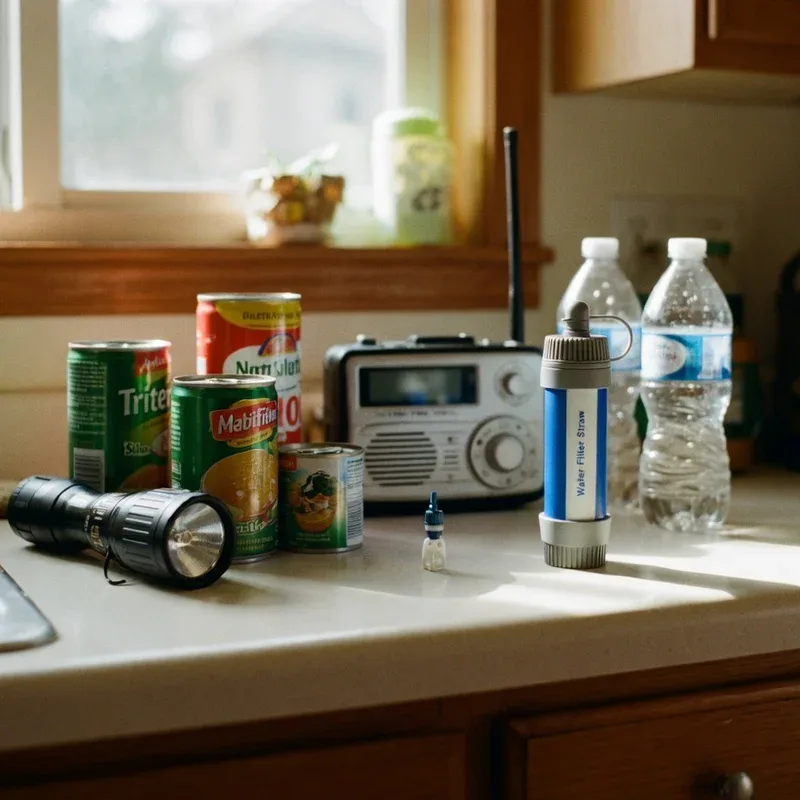
The storm passes, the lights are out, and you open the kitchen tap out of habit. A cough of air, then nothing. Or the water runs, but the city has sent a boil-water notice and your stove is electric. The case of bottles in the garage suddenly looks very small.
That moment is common enough that the government plans for it. The Centers for Disease Control and Prevention (CDC) warns that "after an emergency, your tap water may not be available or safe to use," naming water main breaks, hurricanes and floods [2]. And Ready.gov, the federal preparedness site, says to "store at least one gallon of water per person per day for several days, for drinking and sanitation" [3].
Do that math for a family of four and three days: 12 gallons. That's almost four 24-packs of half-liter bottles, bought before the shelves empty. That's the gap a pocket filter is built to close: instead of storing all the water you might need, you carry the means to clean the water that's already around you.
What is the Survival Sip water filter?
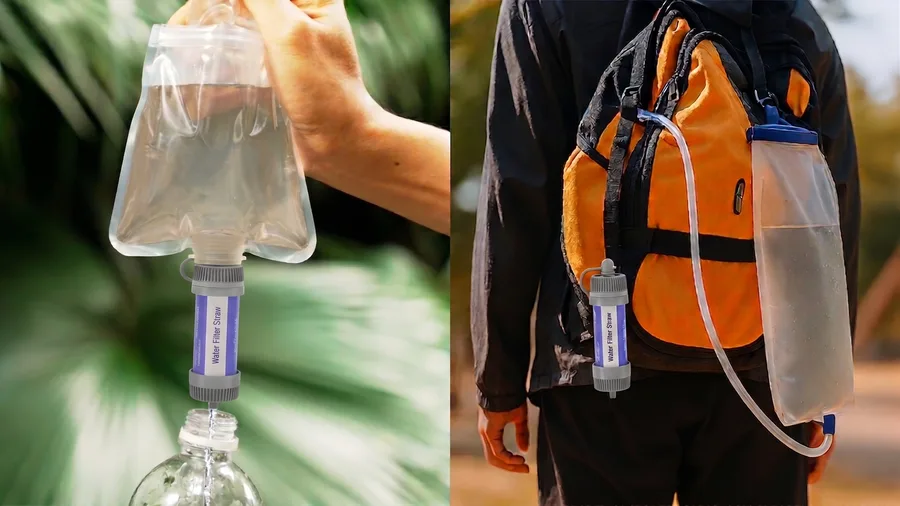
Survival Sip is a pocket water filter: a blue and grey tube about the length of your palm, with a 0.1-micron hollow fiber membrane inside. Survival Sip calls it "Your Family's Water Lifeline in Any Crisis," and the idea is simple. You fill the soft pouch with water from wherever you are, the tap, the bathtub, a rain barrel or a creek, screw the filter on, squeeze, and drinking water comes out the other end.
Survival Sip's product page lists three layers: the hollow fiber membrane, activated carbon and an inner protective layer. It weighs 2 ounces, needs no power, batteries or chemicals, and has no cartridge to replace. Buyers on its page mention that each filter comes sealed in its own wrapper.
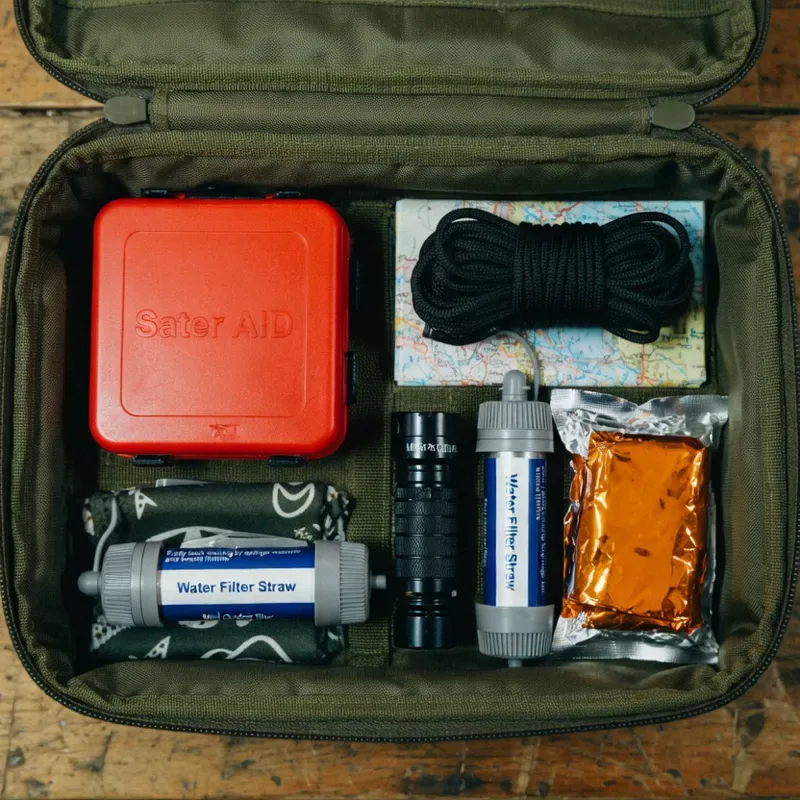
In the box: the filter, a squeeze pouch, a cleaning syringe for backflushing and a carabiner clip.
What does a 0.1-micron filter remove?
A hollow fiber filter works like a very fine sieve: tiny tubes with walls full of pores far smaller than a hair. Water squeezes through; anything bigger stays behind.
Survival Sip says its pores are 0.1 micron. The CDC's guide to treating water outdoors sets the line clearly: "A filter with an absolute pore (hole) size of 0.3 micron or smaller will remove bacteria and parasites, but not viruses" [1]. At 0.1 micron, Survival Sip sits on the right side of that line. That covers bacteria such as E. coli and parasites such as Giardia and Cryptosporidium.
Two things a hollow fiber filter like Survival Sip doesn't handle:
- Viruses. They're smaller than the pores. The CDC's fix is easy: "After filtering, add a chemical disinfectant" such as unscented household bleach [2]. For a gallon of clear water, that's 8 drops of regular 5% to 9% bleach and a 30-minute wait.
- Fuel and chemicals. The CDC says water with fuel or toxic chemicals can't be made safe by boiling or disinfecting it [2]. So in a flood, skip water that smells of fuel; use a filled bathtub, a rain barrel or a clean source instead.
Put together, that's a strong kit: Survival Sip handles bacteria and parasites with no power, and a small bottle of bleach covers viruses.
How do you use Survival Sip, and how long does it last?
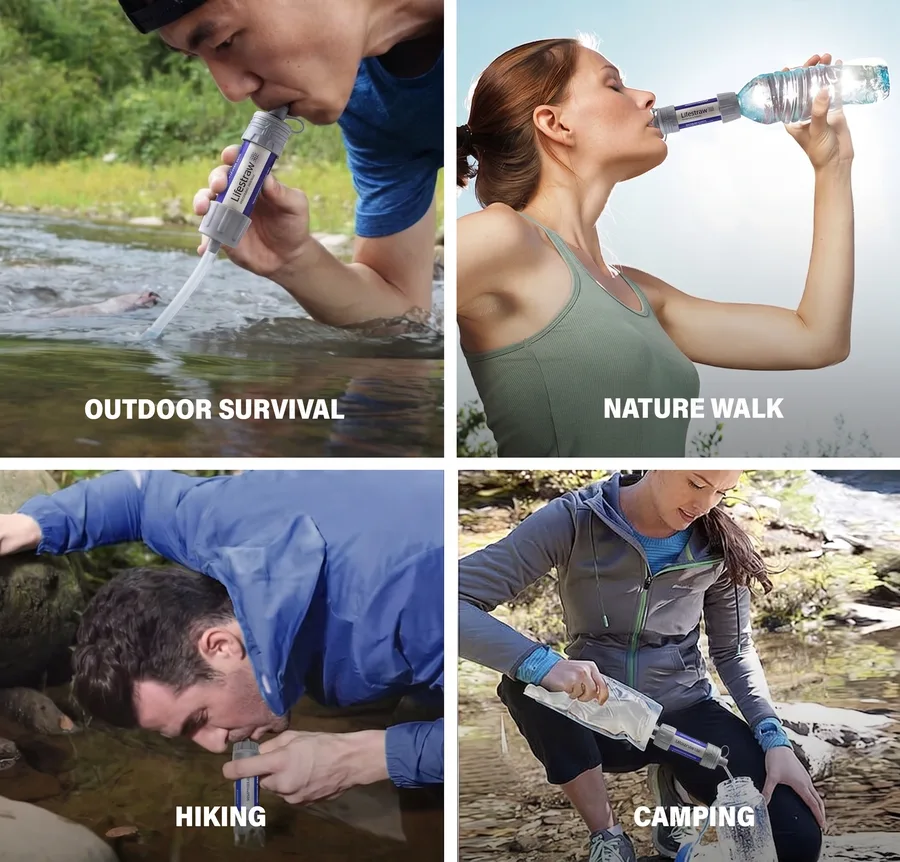
Survival Sip's FAQ lists four ways to drink through it (the fourth is a hydration pack). These three cover almost everything:
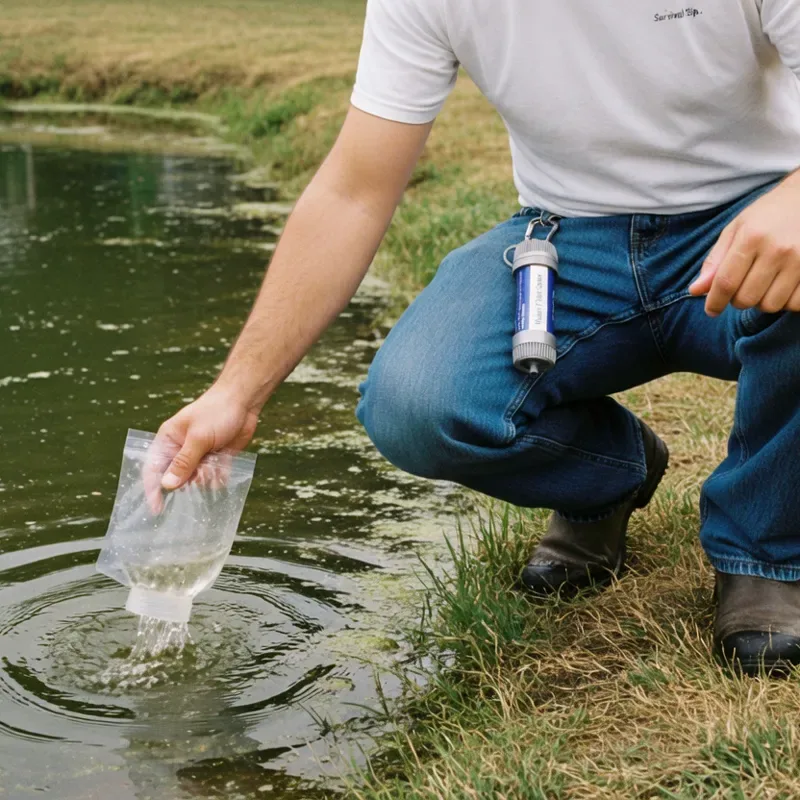
- Squeeze pouch. Fill the pouch, screw on the filter, squeeze into a cup or straight into your mouth. Best at home, from a bathtub, bucket or rain barrel.
- Onto a bottle. The filter threads onto a standard water bottle, so you can fill up and walk away instead of drinking at the source. Best in the car or on foot.
- Straight from the source. Use it like a straw and sip directly from a stream or a jug. Best when you have nothing else.
Keeping it flowing. Any hollow fiber filter slows down as dirt builds up in the pores. The fix is the syringe in the box: push clean water backwards through the filter, which Survival Sip says "helps maintain strong flow and extend its life." If the water is cloudy, the CDC's tip is to let it settle or pour it through a clean cloth or coffee filter first [2]; the filter will last much longer.
How many gallons? Survival Sip's headline is up to 1,800 gallons per filter, and it says the filter has no expiration date. Its comparison chart lists 1,300 and its FAQ goes as high as 100,000 with maintenance; we plan with the lowest, 1,300. Even then, at the three quarters of a gallon a day Ready.gov says a normally active person needs to drink, that's more than four years of drinking water for one person.
Survival Sip vs. stored water, boiling and bleach
You probably have some stored water, a pot and bleach. Here's what a pocket filter adds, based on the CDC and Ready.gov guidance and Survival Sip's own specs.
| Survival Sip | Stored bottled water | Boiling | Bleach | |
|---|---|---|---|---|
| Needs power or fuel | No | No | Yes | No |
| Bacteria | Removed | Already safe | Killed | Killed |
| Parasites (Giardia, Crypto) | Removed | Already safe | Killed | Not reliably |
| Viruses | No: add bleach | Already safe | Killed | Killed |
| How much water | 1,300 to 1,800 gallons per filter | What you stored | What you can heat | What the bottle treats |
| Ready to drink | Right away | Right away | After it cools | After 30 minutes |
| Fits in a pocket or car | Yes, 2 oz | No | No | Small bottle |
What are the pros and cons of Survival Sip?
As emergency gear that has to work on the bad day, Survival Sip gets most things right.
Pros
- 0.1-micron hollow fiber: small enough, by the CDC's own line, to remove bacteria and parasites
- No power, batteries or chemicals, so it works when the grid doesn't
- Three ways to drink: pouch, bottle or straight through it
- Cleaning syringe in the box to keep it flowing, and no cartridges to buy
- From $25 a filter in the 10-pack, so everyone in the house gets one
Cons
- Like other hollow fiber filters, it lets viruses through and isn't made for chemicals. Keep unscented bleach next to it and add 8 drops per gallon after filtering flood or boil-water-notice water.
- Shipping is added at checkout and isn't refunded under the guarantee. Order the pack you need in one go and keep the box while you try it.
One per person, from $25 each.
What do Survival Sip buyers say?
Here are four buyer reviews from the Survival Sip product page, copied exactly. They cover pond water, kids and keeping one in every bag.
After our water was shut off for 3 days during the last storm, I ordered these for the whole family. They are lightweight, easy for the kids to use, and small enough to toss in a bag. Best money I have spent on preparedness gear.
Monica R.
I ran it through a stagnant pond behind my property just to see if it actually worked. Water came out tasting completely clean. I have been testing it regularly for six months and it still performs like day one.
James H.
This filter is tiny but it does serious work. Takes up almost no space and weighs basically nothing, so we keep one in every go-bag, both cars, and the kitchen drawer. You do not think about water until you do not have any.
Linda K.
After the ice storm knocked our power out for 4 days, I swore we would never be caught off guard again. These are so simple my 8 year old can use one without help. No pumping, no chemicals, just fill and squeeze.
Angela M.
Who should buy Survival Sip?
Buy it if you live where storms, ice or earthquakes cut the power or the water, and your emergency plan so far is a case of bottles. Buy it for go-bags and car kits, so every person has water without carrying gallons, and for camping, fishing or hiking.
It's not the right buy if you need to treat seawater or water with fuel in it. For those, stored bottled water is the plan.
How much does Survival Sip cost?
On November 27, 2026, with the discount already applied, the official checkout listed these prices. One filter costs $34.99. Two cost $65.00 ($32.50 each), three cost $95.97 ($31.99 each), five cost $144.95 ($28.99 each) and ten cost $250.00 ($25.00 each). Prices change with promotions, so the checkout always shows today's number. Shipping and tax are added once you enter your address.
Per gallon: a $28.99 filter over the 1,300 gallons on Survival Sip's chart is about 2 cents.
Which pack? The rule that makes sense is one filter per person, plus one for the car. For a family of four, that's the 5-pack, our pick. A couple is covered with two or three; the 10-pack at $25 a filter is for bigger families, several go-bags or spares for parents and neighbors.
5 Survival Sip filters
$144.95 ($28.99 each)
One per person for a family of four, plus the car.
How do Survival Sip's guarantee and shipping work?
90 days to decide. The checkout states a 90-day money-back guarantee: send the filters back in the original packaging for a full refund or a replacement, less shipping and handling. That's three months to try it on the tap, a barrel or a creek.
The catch is small: the box has to go back with them, and what you paid for shipping stays spent. So test one filter first and leave the others unopened until you've decided.
Shipping. Survival Sip's FAQ says orders leave within 48 business hours and standard delivery usually takes 2 to 3 days; its terms give a wider range of 3 to 7 business days after shipping. Tracking comes by email.
90-day guarantee, in the original packaging.
Is Survival Sip legit or a scam?
Survival Sip is a real product of a proven type, and that's a good thing. Hollow fiber squeeze filters have been trusted by hikers for years, and the CDC describes exactly what a filter with pores this small can do. So is it just a hiking straw with a new name? Partly, and here's what you get on top: an activated carbon layer, by Survival Sip's description; a full kit with pouch, cleaning syringe and clip; and a price that drops to $25 a filter, low enough to give one to every person in the house.
Where people get confused is the search results. Several sites use the Survival Sip name, and a lot of "reviews and complaints" pages sit on random hosting with no company behind them. Orders and support run through the official site, with posted terms, a phone line staffed on weekdays and the 90-day guarantee in writing. Order there, pay by card and keep your confirmation email, so the guarantee and the support line apply to you.
Kit with pouch, syringe and clip, from $25 a filter.
Survival Sip Water Filter FAQ
What is Survival Sip?
A pocket water filter with a 0.1-micron hollow fiber membrane and activated carbon. You squeeze water through it from its pouch, drink straight through it or attach it to a bottle. No power, batteries or chemicals.
Does Survival Sip really work?
For bacteria and parasites, yes. The CDC says a filter with pores of 0.3 micron or smaller removes bacteria and parasites, and Survival Sip's membrane is 0.1 micron.
Does Survival Sip remove viruses?
No. Viruses are smaller than the pores of a hollow fiber filter. The CDC advises adding a disinfectant such as unscented household bleach after filtering: 8 drops per gallon of clear water, then wait 30 minutes.
Can I drink floodwater with Survival Sip?
Only if it's free of fuel and chemicals, and with bleach added after filtering. The CDC says water with fuel or toxic chemicals can't be made safe by boiling or disinfecting it.
Can kids use Survival Sip?
Survival Sip says it's "so simple a child can use it": fill the pouch, screw on the filter and squeeze. Show children once and keep an adult in charge of choosing the water.
How many gallons does a Survival Sip filter last?
Survival Sip says up to 1,800 gallons per filter; its comparison chart shows 1,300. At three quarters of a gallon of drinking water a day, even 1,300 gallons is more than four years for one person.
Does Survival Sip expire?
Survival Sip says the filter has no expiration date and no cartridges to replace.
How do I clean the Survival Sip filter?
Backflush it: push clean water backwards through the filter with the syringe in the box whenever the flow slows down.
How much does Survival Sip cost?
At the official checkout on November 27, 2026: $34.99 for one, $31.99 each for three, $28.99 each for five and $25.00 each for ten. Shipping and tax are added at checkout.
How many Survival Sip filters should I buy?
One per person, plus one for the car. A family of four is covered by the 5-pack; the 10-pack suits bigger families or several go-bags.
What is the Survival Sip return policy?
A 90-day money-back guarantee: send the filters back in the original packaging for a full refund or a replacement, less shipping and handling.
How do I contact Survival Sip?
By email at support@unbindgear.com or by phone at 1-888-852-0196, Monday to Friday, 9 am to 5 pm.
Sources
Checked on November 27, 2026.
- Centers for Disease Control and Prevention (CDC). About Water Treatment Options When Hiking, Camping, or Traveling. Link
- Centers for Disease Control and Prevention (CDC). How to Make Water Safe in an Emergency. Link
- Ready.gov, U.S. Department of Homeland Security. Water. Link
- Survival Sip. Product page, FAQ, checkout, terms and contact page (official site), checked on November 27, 2026.
Is Survival Sip worth it?
For a family that wants water covered when the power or the tap fails, yes. A 0.1-micron pocket filter removes the bacteria and parasites that make people sick, needs no power, and Survival Sip says it has no expiration date. Add bleach for viruses, test one filter while the guarantee runs, and plan on one per person plus one for the car: for a family of four, that's the 5-pack.